Engineering Elite Wet and Sand-Dressed Hockey Pitches Configured for International Championships.
Modern field hockey has evolved into a game of extreme speed, precise ball movement, and fluid player dynamics. The transition from natural grass to synthetic turf in the 1970s revolutionized the sport. Today, international and elite-level national hockey matches are played exclusively on certified synthetic turf fields.
Elite International Sports is a premier sports infrastructure developer, specialized in designing, engineering, and constructing state-of-the-art **FIH Certified Hockey Astro Turf fields**. Working in strict adherence to the International Hockey Federation (FIH) Quality Programme, we provide turnkey installation solutions that cater to international stadiums, university academies, schools, and private clubs.
Our synthetic turf systems are configured from premium polyethylene monofilament fibers, woven using specialized texturing techniques. From a sports engineering perspective, a hockey field must exhibit uniform ball roll, consistent ball deviation, and high shock-absorption properties. The surface must accommodate sudden directional changes, slides, and heavy stick impacts without causing joint fatigue or skin abrasions.
Whether you require a **Global Category 1 (Water-Based Wet Turf)** for high-profile championships, or a **National Category 2 (Sand-Dressed/Sand-Filled)** system for training centers, our engineering team manages the complete cycle of development. We handle advanced geotechnical site assessment, laser-guided sub-base preparation, dynamic shock pad laying, synthetic turf alignment, and FIH certification tests.
The performance parameters of a professional hockey turf are critically measured by ball-to-surface and player-to-surface interactions. A flat, uniform sub-base is crucial; a minor deviation in leveling can cause unpredictable ball deviations, which is unacceptable in competitive play.
Our pre-fabricated and cast-in-situ shock pads provide a force reduction of 35% to 45%. This significantly minimizes impact stress on the knees, ankles, and spine, reducing long-term injury risks.
Our sub-surface drainage matrix has water percolation rates exceeding 180mm per hour. This allows match play to continue even during heavy tropical monsoon downpours without water ponding.
The turf fibers are UV-stabilized to withstand extreme solar radiation (up to 150 kLy/year), maintaining color fastness, fiber structure, and playing speed for 8 to 10+ years.
Constructed using high-density Dtex monofilament yarns, our turf surfaces exhibit superior resistance against wear from footwear studs and hockey stick friction, ensuring consistent playing speed.
We install three major types of hockey surfaces depending on standard requirements and budgetary configurations:
Used for elite-level international tournaments. It features a dense, short-pile surface with no sand infill. A uniform film of water must be sprayed prior to play, which lubricates the turf, reduces heat, stabilizes ball direction, and allows speed-sliding.
Features texturized fibers partially infilled with round-grain silica sand. The sand supports the base of the fibers while leaving the tips exposed. This system offers excellent ball speed, does not require watering, and is highly popular for multi-sport school grounds.
Filled almost to the top of the pile with silica sand. Highly cost-effective and extremely durable, this surface is suited for local community parks, multi-purpose recreational play, and training academies.
Incorporate bio-based monofilament materials and advanced cooling technologies. Requires 50% less water than traditional wet fields while maintaining international traction parameters.
Our construction follows standard civil and sports engineering protocols to guarantee structural integrity and surface flatness:
Geotechnical evaluation to test soil load-bearing capacity. Laser-controlled excavation is performed to level the field profile.
Excavation of herringbone pattern drainage trenches, installation of perforated HDPE drainage pipes wrapped in geotextile sheets.
Laying graded aggregates in two separate layers (coarse and fine stone), compacted using heavy rollers to achieve a deviation of less than 3mm under a 3-meter straight edge.
Applying a dual-layer hot-mix asphalt base or reinforced M25 concrete slab, creating a highly stable foundation that prevents sub-grade settlement.
Installing a premium prefabricated EPDM rubber shock pad (8mm to 10mm thickness) or casting in-situ rubber crumb cushions to deliver calibrated bounce and safety.
Positioning synthetic turf rolls, gluing seams using high-tensile PU adhesives, cutting and tufting white and yellow boundary line markings according to FIH layouts.
Field testing ball roll speed, ball rebound height, vertical deformation, and water distribution. Official handover certificate issued.
High-performance Polyethylene monofilament yarns (typically 7,000-11,000 Dtex) structured for heavy friction.
Prefabricated rolls made from high-grade recycled SBR and EPDM granules bonded with polyurethane.
Two-part weather-resistant polyurethane adhesives for durable seam bonding and line markings.
Sub-angular, washed, kiln-dried silica sand (99% pure) to avoid fiber friction in dressed systems.
High-permeability non-woven membrane to separate sub-grade soil from base gravel while allowing drainage.
Grade 60/70 penetration asphalt concrete mix laid with precise grade controls to provide structural strength.
Prevents cleats locking and skin abrasions during hard slide tackles, keeping players active.
Resilient base layers do not freeze, crack, or mud-clog, allowing play across hot and sub-zero conditions.
Materials used are non-toxic, preventing heavy-metal leakage into local groundwater tables.
| Playing Standard Compliance | FIH Global / National Standards (Class 1 & Class 2) |
| Turf Pile Height | 11mm to 13mm (Texturized Monofilament) |
| Fiber Composition | Polyethylene (PE) - UV-Stabilized |
| Shock Pad Thickness | 8mm - 10mm prefabricated EPDM rubber pad |
| Drainage Rate | > 180mm / hour |
| Expected Lifespan | 8 to 12 Years (under standard maintenance) |
| Warranty Coverage | 8 Year Comprehensive Manufacturer Warranty |
| Water Requirement (Wet) | 15,000 - 18,000 Liters sprayed per match (wet systems only) |
Our execution is guided by qualified civil engineers and court agronomists with 15+ years of sports flooring experience.
We use advanced laser graders, automated asphalt pavers, and turf tufting machines to achieve sub-millimeter level accuracy.
With offices and material hubs across major cities, we execute projects on-time and within budget anywhere in India.
We handle everything: survey, soil base consolidation, asphalt paving, turf installation, lighting, fencing, and certifications.
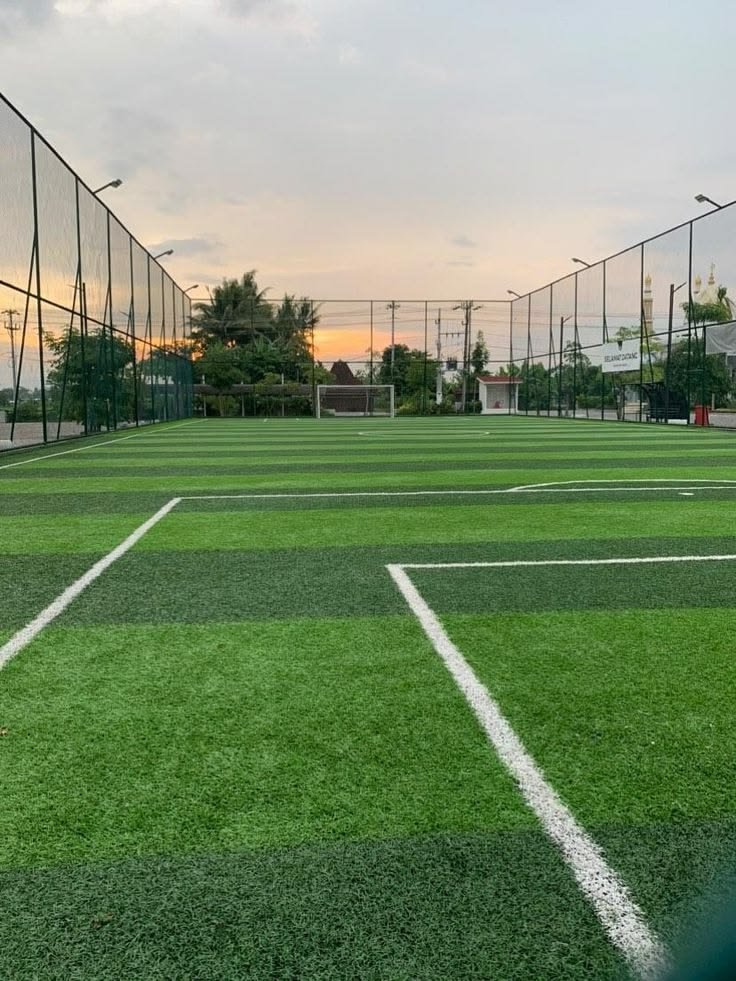
Turnkey FIH Certified Wet Turf Installation
Submit details about your institution's field dimensions. Our engineers prepare preliminary drainage plans and BOQ estimates.
Get technical layouts, base-foundation designs, and comprehensive costing sheets prepared by our expert sports engineers.