Engineering Robust Galvanized Steel Cages, High-Tensile UV HDPE Netting, and Astro Turf Practice Pitches.
Practice is the foundation of cricketing skill. To maximize practice efficiency and player safety, cricket academies and clubs require dedicated practice net facilities.
Elite International Sports specializes in designing and building **cricket practice nets**. In strict compliance with structural engineering standards and cricketing requirements, we construct heavy-duty fixed outdoor net cages, retractable indoor netting screens, and movable practice cages for academies, schools, corporate offices, and private residential estates.
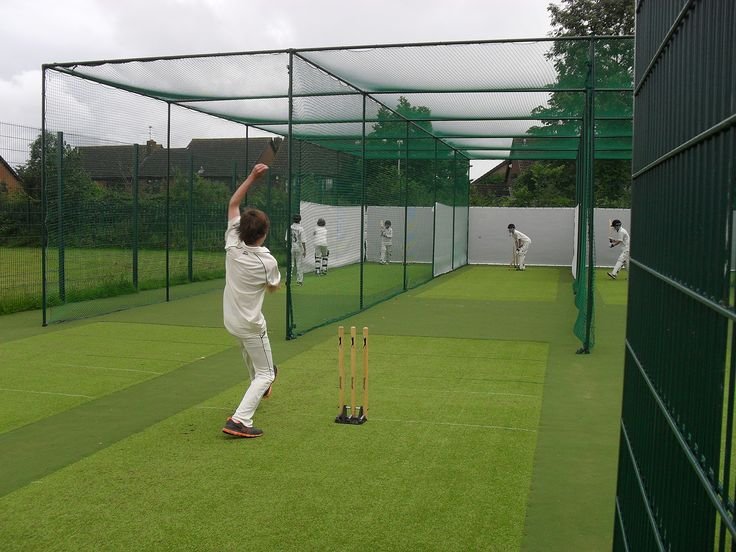
From a structural perspective, a cricket net cage must withstand intense wind loads and high-velocity ball impacts. We utilize heavy-gauge **galvanized steel framing pipes** grouted deep in concrete footings. The netting is crafted from **high-density polyethylene (HDPE)**, UV-stabilized to prevent solar weathering, and textured to absorb impact energy without tearing. Below the net cage, we construct reinforced concrete slabs topped with premium **synthetic cricket turf**, delivering a consistent practice bounce.
Our team manages the complete installation, including site layout, pole foundation grouting, concrete base paving, turf gluing, steel framing assembly, net hanging, and crease lining.
Practice nets must be designed to isolate batsmen and bowlers, protecting adjacent properties and nearby players from stray ball impacts.
Our HDPE nets utilize knotless braids to absorb ball impacts up to 160 km/h, preventing rebound injuries.
Net fibers are treated with UV-blocking agents, preventing fiber brittleness and decay in extreme heat.
Heavy-gauge galvanized pipes resist corrosion and wind loads, maintaining structural stability.
High-density synthetic turf laid over concrete bases replicates natural wicket bounce for realistic batting practice.
We design and build three primary net configurations to match school and academy setups:
Features ground-anchored steel posts grouted 600mm deep in concrete, supporting a permanent net structure. The most durable choice for academies and school sports complexes.
Uses self-supporting steel frames fitted with heavy-duty caster wheels. Allows coaches to move the net cage across different turf wickets to prevent wear on any single pitch.
Suspends the nets from overhead steel tracks in indoor arenas. Netting screens can be rolled back or drawn using pulleys, allowing the space to host badminton or basketball.
Compact, single-lane net systems designed for private residences. Built with lightweight steel pipes and soft turf surfaces to fit garden landscapes.
Our construction process focuses on frame stability and concrete levelness:
Excavating the pitch table area and drilling 600mm deep pole foundation holes at framing anchor points.
Placing heavy steel framing posts in foundation holes, securing them vertically, and pouring M20 concrete anchors.
Pouring a 100mm thick reinforced concrete base slab over a gravel aggregate bed, finished to a flat profile.
Applying an outdoor adhesive primer and bonding the 15mm synthetic grass turf carpet to the concrete base.
Assembling the galvanized steel top and side horizontal cross-members, securing joints with lock-bolts.
Hanging the HDPE netting cord from the top rails, securing the side perimeters, and tensioning ropes.
Installing heavy canvas backing sheets behind the batsman's stumps to absorb hard hits, followed by handover.
UV-stabilized knotless high-density polyethylene cord netting (16-18 ply, 35mm mesh).
Galvanized structural steel pipes (32-48mm diameter) to resist corrosion and wind loads.
12mm-15mm polypropylene grass carpet designed to withstand heavy player spikes.
Reinforced M20 concrete slab paved with precise grade controls to provide structural strength.
Weatherproof polyurethane and epoxy resins to secure turf carpets to concrete bases.
Heavy-gauge key-clamp pipe connectors and clamp bolts for frame cage assembly.
Isolates practice areas, containing high-velocity balls to prevent injuries.
Allows multiple batsmen and bowlers to drill simultaneously in adjacent lanes.
Weatherproof steel cages and synthetic turf require minimal maintenance.
| Netting Material | High-density polyethylene (HDPE) - UV-Stabilized |
| Net Twine Thickness | 16-ply or 18-ply (knotless braid structure) |
| Mesh Size | 35mm x 35mm (standard cricket ball isolation mesh) |
| Frame Structure | Galvanized steel pipes (42mm to 48mm OD, 2.5mm wall thickness) |
| Standard Lane Dimensions | 35-45 feet long x 10-12 feet wide x 10-12 feet high |
| Synthetic Turf Pitch | 12mm-15mm polypropylene texturized grass carpet |
| Sub-base requirement | 100mm reinforced concrete slab on gravel aggregate bed |
| Expected Lifespan | 8 to 10 Years (steel framing and synthetic turf) |
| Warranty Coverage | 5 Year Structural Framing Warranty / 2 Year Net Warranty |
We use only high-tensile, knotless HDPE nets that absorb ball impacts without cord slippage.
Our structural pipe frames are hot-dip galvanized to resist corrosion in high-humidity climates.
We design practice cages in single-lane, dual-lane, and multi-lane blocks to fit academy layouts.
We manage the full cycle of installation, including concrete base casting and synthetic turf laying.
Hot-Dip Galvanized Cages and Astro Turf Practice Pitches
Submit details about your institution's field dimensions. Our engineers prepare preliminary drainage plans and BOQ estimates.
Get technical layouts, base-foundation designs, and comprehensive costing sheets prepared by our expert sports engineers.